
On Rust
Comment


I have been learning Swahili. New words added to the vernacular: mushikana (busy), malisa malisa (hurry, hurry), babayangu (my dad), shookran (ta), tooliv (calm), kokosamilelieko (I am chaotic), and ninacheka (laughing) (note - these are my phonetic Whatsapp notes, do not use in spelling tests).
My goodness me is this pleasing. Every day I add a few more blocks - a sherre (party) here, a kitoongu (onions) there, and each taxi ride I can get further and further along in the journey before I hit up against the limits of what I am able to say. I feel like I’m building up my knowledge of the language, one brick at a time. One day I’ll have an indestructibly solid castle, Levine’s Eternal Palace of Swahili-Fluency, and will be able to yammer away in Kiswahili forever more.
Except… I’ve also at points in my life been able to speak Spanish. And a little French. I’ve had a rudiment of Italian; a smidge of Swedish; the smallest smattering of Ethiopian. The Spanish is now dusty, the French near-non-existent, and the others have disappeared all together. Which makes my current faith in the Eternal Palace of Swahili Fluency seem a little … optimistic.
Over time, the knowledge of all those other languages eroded. Even as I learn more and more Swahili, those other languages are being forgotten, slipping out unnoticed and unremarked upon (because you don’t notice what you are forgetting). Which makes me think this knowledge is a little more like building a palace on a cliff edge, subject to heavy winds. Even as every block is being put into place, the rest of the edifice erodes, leaks away into the sea. You can spend your day building up one wall, or fixing a patch, and feel you have accomplished something - but the building has remained the same size, simply weathering away elsewhere.
I’ve been reading ‘How to End A Story’ by Helen Garner, and it seems she has swallowed this Eternal Palace hook line and sinker. The book is littered with phrases like: “My intellectual equipment has gone rusty. And has never developed to its full strength in the first place. I get frightened when I think it may be too late.” She’s constantly terrified that she has peaked, that had her shot at brilliance, and - through rest, or frittery - it has left her.
I can see she follows the Eternal Palace line - because for the first part of our life, the rate at which we learn new information exceeds the rate at which we forget it. We do, almost inarguably, know more at 16 than we did at 12, more at 12 than we did at 8. But I also think there’s a point where the rate at which we’re learning new information, and the rate at which we forget it are roughly level. The Eternal Palace model works(ish) for the first part of our life, but the Eroded Palace works for the second.
And I think there’s a lot of benefits to adopting this. One is it’s more egalitarian. I don’t, really, think I know more than a 21 year old, or that a 30 year old knows more than me (having an oddly wise baby sister may have contributed to that…). Stuff falls in and out of our heads, and we both have one full brain.
The second is it’s a lot less frenetic. When I read Garner write of ‘All that knowledge I once had, dissipated for lack of use', I wanted to say ‘But of COURSE! It’s been swapped for other things! That’s just LIFE.’ You get the sense she is terrified she is falling behind, that there is always someone with more knowledge, more books, opinions, skills, facts. That if she’s not building as quickly as her compatriots, she’ll fall away from them. She’s putting so much pressure on herself - that what she chooses to think and focus on now determines what she’ll have access to for ever more.
But if the palace is falling away anyway, it becomes more a matter of choosing what you wish to build. There comes a point where you’re just swapping - some knowledge is falling out of your head, other knowledge is falling into it, and it’s happening about the same rate. You can’t fall behind - you just choose what you want to focus on. And so we’re all on a pretty level playing field. If you wanted to become really, really expert at … military strategy, you’re never at an insurmountable disadvantage for not swallowing ‘The Art of War’ age 3. You’ve just got to spend a decent chunk of time filling your head up with that information.
Right now, I’ve forgotten a lot of things. I can’t read Kant like I did, my Spanish is clunky and slow, my maths is far, far worse than when I was younger, and my knowledge of politics has never been lower. Instead, there’s a bit more Swahili, some basic coding, Garner’s diaries, a ton of Love Island All Stars, a little bit of poetry, and elephants. And that mix is all good with me. If - later on - I want to dust off Spanish or re-alive the Italian instead, I can do that - and I’ll have to swap it in for something else. Something else will fall out instead.
If everything does fall out of our heads, artefacts become much more important. It isn’t just being able to think brilliant ideas, but being able to evidence what you think right at the moment when a lot of what was in their head related to a particular topic. Think of a professor. When that Professor knew absolutely everything there was about the Argentinian economy, or the US expansion into Alaska, they evidence it. They write down those thoughts, and then refer back to them, see the conclusion they drew without having to reacquaint themselves with the premises. In this way, they can build up via their own set or web of different ideas (more in ‘On Ignorance), and construct up from them - trusting in the knowledge of their former self, even if the original information isn’t available to them anymore. So skill is not just thinking, it’s recording, and finding the best way to do this.
I noticed as I read Garner’s writing that I wanted to note down what I thought - my own loose epigrams, phrases, fragments (a credit to the book). I’ve come back and my handwriting is UTTERLY illegible. I have genuinely no idea what I’ve written. And it seems odd that this inability to write will have a bigger impact, long term, than how much I focused as I read the book, or even how many thoughts I had - because it’ll be impossible to come back to them. I wonder how the Eroded Model shifts the emphasis - suggesting we need more of a focus on coursework, systems of record, notetaking and so on - how to build artefacts, not just being able to conjure up thoughts on demand.
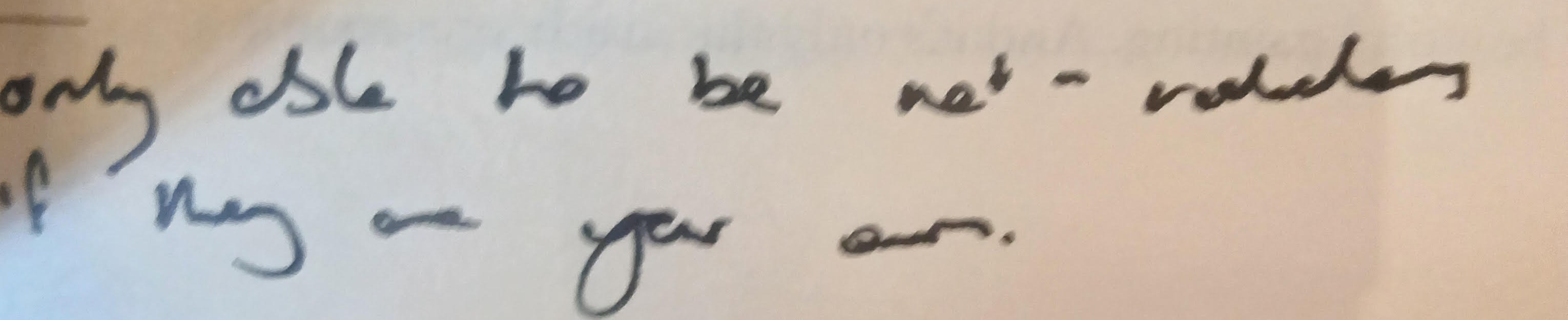
Any ideas?
There were a lot of gems in How to End A Story (and a good thing to, given it was EIGHT HUNDRED PAGES and not in Big Fonts). Garner is brilliant at using italics and punctuation to give her writing a real sense of voice - describing how her daughter ‘actually sat on my knee and leaned against me for at least ten minutes’ You can hear her! It makes for a slight artifice at points - for instance, she occasionally writes as if she is thinking (‘Ayers Rock? It could be a novel. Oh, calm down.) - which isn’t possible, because no one writes as fast as they think - and I found this bothersome - it undermined the authenticity of the diaries.
Regardless, there’s some fabulous terms of phrases - describing a book as ‘full of depths if not widths', ‘a voice almost oily with the desire to appear cooperative’, of how ‘ideas come to you. Connections strike off each other with rinign blows or slot together like carpenters joints’, of an ocean that was ‘chirping with light’, a sky ‘stained, tipped, scaled, looped, and daubed’, a sunset ‘a long pink cloud, ridged as neat and fine as salmon flesh.’
It struck me how curated writing in general is. At one point she quotes Handke’s diary ‘The Weight of the World’, saying ‘It was a bright, pure, friendly night, reasonable through and through’. Now the feeling of this night got picked out by Handke from his day to write down in his diary. When the diary got edited, it survived again. It then got picked out from his diary Garner to quote in her diary. It survived another edit. And then the exact same thing has happened here. So Ivhope you enjoyed the description of that ‘reasonable through and through’ night! Because it’s gone through an awful lot of triaging to get here. I realised she had picked out things, and out of her picking-out-of-things, I was picking out more things, and of those I’d picked out, you may pick out another again.
It’s interesting too, how I look through my copy and there are bursts where tons of things are underlined - when she is at her best - and pages when there’s nothing of note. She has whole years where I felt like everything was dross, only to come up to a few months where entry after entry makes me feel something. And it shows something that everyone knows - people have periods of the best and lesser work - but it seems fine observing that in someone else, utterly intolerable to think of yourself as having a whole year, writing every day, where nothing was any good. Something not to think about too much.
I am going to write more about this - about if this model is really egalitarian and if not how, and how to square this with the fact we clearly do value expertise - so, under the Eroded Model, what it is it we actually value when we do so. I wonder if the reality is that instead we spin and spin, but build up a layer sediment over time. I want to (basic but true) also think about implications for AI. I also have a ton of things I ought to read (CS Lewis On Criticism; Emerson On Self Reliance; The Shallows). But I have been sat on this for a week, and thought it was worth ripping the plaster off.
Last up - great words I stole: neurasthenic, fossicking, Künstlerroman (bildungsroman but focused on an artists development), gasbagging, splendiferous