
On Poetry
Comment


“No. More. Fucking. Poems.”
The town of Ronco Scrivia in Italy has lots of poems dotted about. Framed, they pop up unexpectedly in different spots around the town. These hits of culture are a lovely idea, and something that I - en route to a poetry conference - ought to be very pleased with. Normally, I would have been. I love cultural installations, street art, Poems on the Underground - I’m all for a cheeky saucisson of culture. But in this instance, I was a bit less enthused. I did not like the poems. I did not like the poems because of what they were not. Which was road signs.
I needed road signs because I needed to find Via Barberi. I needed to find Via Barberi because I was following my Google Maps to a place called Via Barberi 2. Which was where the philosophy conference was. At the moment, I was having to orient myself with no service in an unfamiliar country. I could see on my phone that there was a river, and then the road, and then Via Barberi. I was, apparently, on the adjacent road. Except I couldn’t be. Because there was a river there.
I followed the small heart shaped destination pin on my Google Maps to a bridge, marked privado. This was very much an Italian, as opposed to, say, a German bridge - characterful, but not particularly sturdy. Rickety wooden slats looked mouldy and treacherous, and I decided to turn back. Then, in the sheeting, sleeting rain, I caught a glimmer of movement! An elderly woman and her even more elderly mother - Sal and Vation. They told me in Italian that Via Barberi was the grey building the next side over. I wandered round the streets, passing the 268, 174, 16, 192, growing ever more sodden and wondering whether I should have learnt the Fibonacci sequence so that I could divine the Italian road numbering system, and discover - at last - where Via Barberi 2 would be.
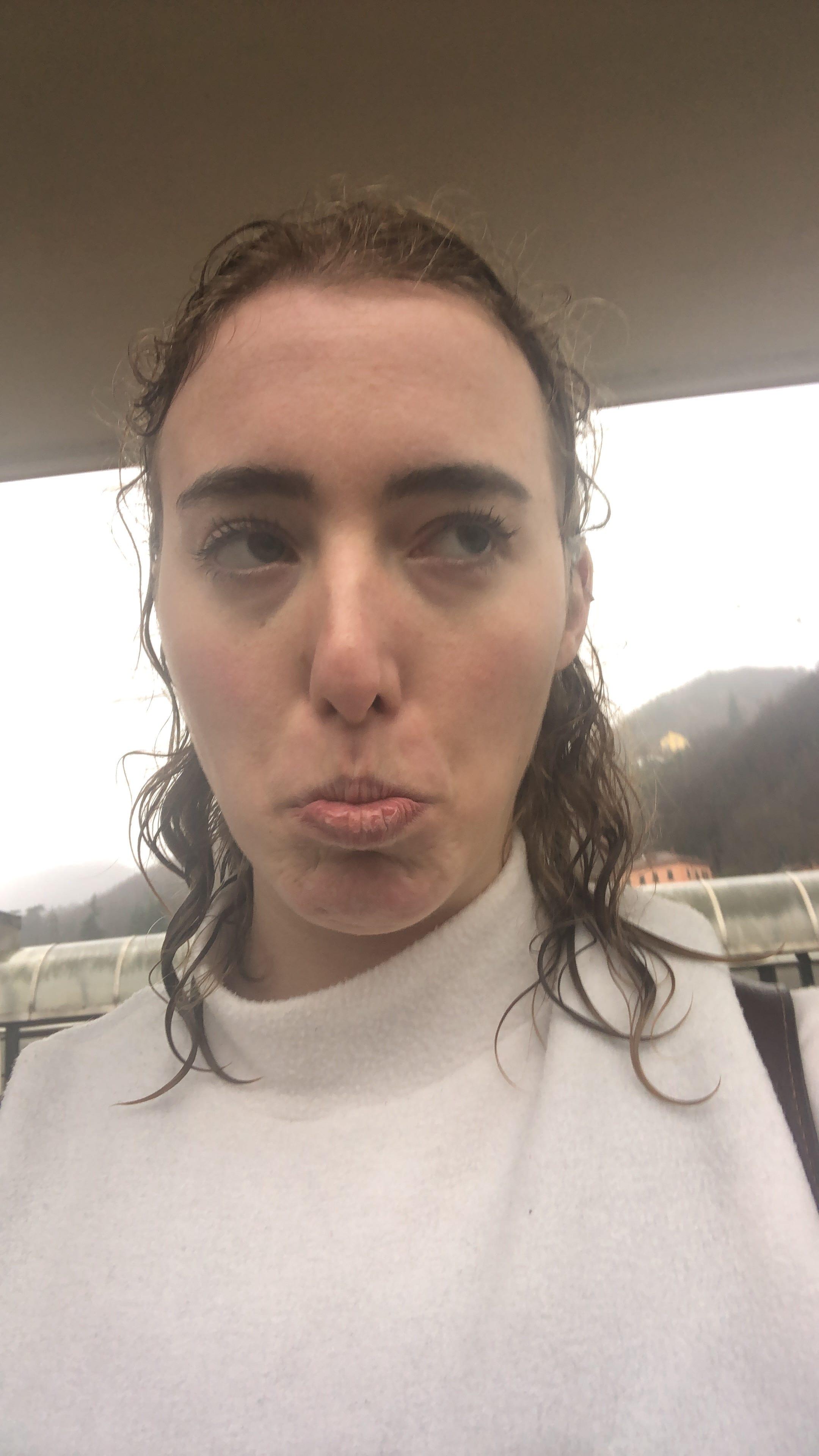
Me, struggling to see the funny side c. 2 hours after hypothermia kicked in.
Teeth chattering, at last I saw my Hermes, my Virgil, my Gabriel - Manuela, a post office worker, shining like a beacon in head to toe high vis. If anyone else had the divine insight to navigate the wily streets of Ronco Scrivia, surely she was my best bet. With a combination of gestures and hope, she informed me to go right, and then right again, and then up - and there I would find Via Barberi 2.
And lo and behold, I found it! VB2! The Promised Land! A large, long drive led up to a pleasingly symmetric yellow house. I could see a gentleman inside, buzzed the door and walked up. Maybe a poets home? Maybe a family home converted into a conference hall? Who knows? He came outside, slow, stately, navy-suited, pointy-shoed, pinched hat, wire glasses on the broken veins of his cheeks. He certainly looked like a poet. He did not, however, sound like one. The stream of bemused Italian that followed may have been some cutting edge spoken word - a piece entitled ‘What is this strange wet woman doing outside my house?’. But I surmised that it probably wasn’t, and made my sopping way back out.
At this point, I had been travelling for 8 hours for a journey that was meant to take 2. I had woken at 6, navigated Milan’s unfamiliar subway system, dealt with a 2 hour ‘ritardo’ or delay, a missed connection, and finally schlepped around a small suburban town for 40 minutes in relentless rain. I tried to romanticise my situation, focus on the anecdote this would generate instead. I failed. I did not feel like a literary being. I felt like a wet one. Traipsing on my sodden way, I found - again - Manuela. My high-vis angel saw my increasingly dejected state, and whipped out Google Translate. She identified that the town I actually needed to be in was a good 40 minutes away. The philosophy post-doc organising the conference linked the wrong Via Barberi in his email (which even I find impressive). Manuela, queen that she is, chucked me into her Fiat Panda and funnelled me to the station, and, at long last, I arrived.
***
Alhamdulillah one, I had worn sufficiently synthetic fabrics in dark colours which didn’t - mercifully - show the litre and a half of water they’d absorbed. Alhamdulillah, two, I was scheduled at 2.30, not the 2.00 I’d assumed, making my 1.45 arrival a little more manageable. Alhamdulillah, three, I had a claw clip on me to hide my soaked hair. So I presented, apologised for my bedraggled state and managed to make my way through (for deets on the content check out the original Substack here… I developed it for the talk, but the gist is similar.) A lot of learning and thoughts about what I’d do differently next time - but first Grown Up Academic Conference presentation done!
*** The Nerdy Bit: Scroll to next ***’s if you don’t fancy ***
A lot of the conference focused on artificial intelligence and poetry. AI poems are, often, functionally equivalent to poems by poets - they’re rated the same or better in blind tests. Most of the time, we have no idea about the background of the poet we’re reading - it’s rare that we use biographical information in our appreciation of the poet - and so, in the vast majority of cases, the lack of background information about an AI doesn’t change how we relate to the poem. Much as we may like to say there’s a particular ‘human touch’, or a coldness lacking from AI poetry, the data suggests not. There’s not really any identifiable difference between the two.
One of the talks - Bayesian Poetics - looked at one of the patterns LLM’s might use to write effective poetry. They suggest that there’s a sweet spot of surprise that creates patterns of language we like. So ‘the dog barks’ = boring; ‘the pineapple barks’ = too weird to make sense, ‘the parrot barks’ = just right. Different words can be ranked by their ‘surprisal’ (lovely word), based on what percentage of people fill a blank with it - in response to ‘the ____ barks’, most people will write dog - so it has a high surprisal. I really liked this paper, because it involved psychologists. I found a lot of the conference involved people making claims about the world that could and should be tested. If we can’t identify a difference in quality between AI and human poetry, we shouldn’t simply assume one exists. (I feel like there’s a range of other tests you can do. For instance, ask people who have been blind/ deaf since birth to write poetic commentaries, and see how they are ranked in comparison to people who can hear - could give us an indication of the importance of form or sound for the critical appreciation of poetry.)
A better way of splitting AI and human poetry is by looking at normative differences . There’s a bunch of candidates (obligations to the artist; concerns about plagiarism and more) - but I’m going to focus on one from eco-poetics (nature poetry). One of the talks discussed the importance of the acquaintance principle - of poets who write about nature having genuinely experienced it. AI can’t do this. Even if an AI writes a poem about the ‘bee-loud glade’, it can’t have been there. I thought a little about how, because AI is trained on data that already exists, any nature poetry it writes isn’t representing the world as it is today. And as the world is currently in climate free-fall, AI poetry is guilty of a ‘sin of omission’ - it won’t represent the changes in nature as they occur. It’s a harm that AI poetry cannot avoid committing.
***
*** Nerding Over ***
Generally, Italy has been glorious. A and I kicked off at a pizza place in Milan that stayed open for another 20 minutes, just for us. Peach walls, black and white photos, bamboo chairs stacked up on tables, we ate phenomenal pizza at midnight whilst the owners and their friends sat smoking, chatting and gesturing at the small screen in front of them - I felt like I could hear the static from a 1920’s film. The food is divine, and Genoa is utterly spellbinding - and I feel like I’ve given academic life a suitably philosophy-and-pastry heavy send-off!
Coda: Some funky poems from the conference!
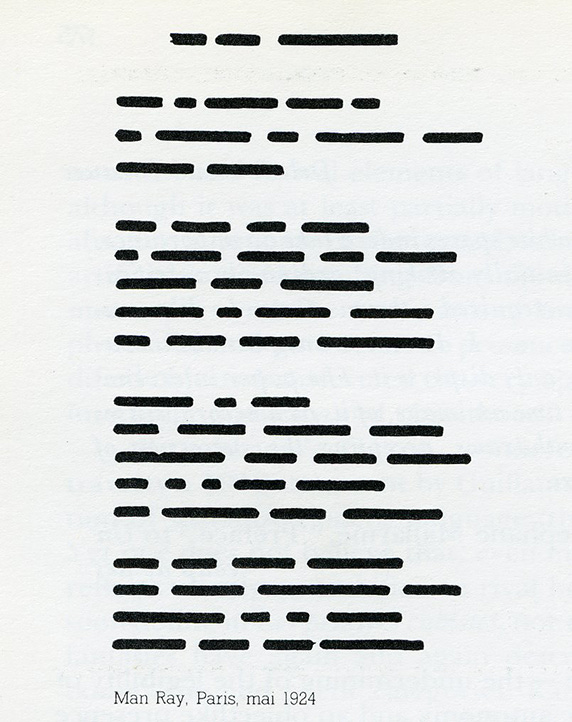
Poéme Optique - can a poem just be the form?
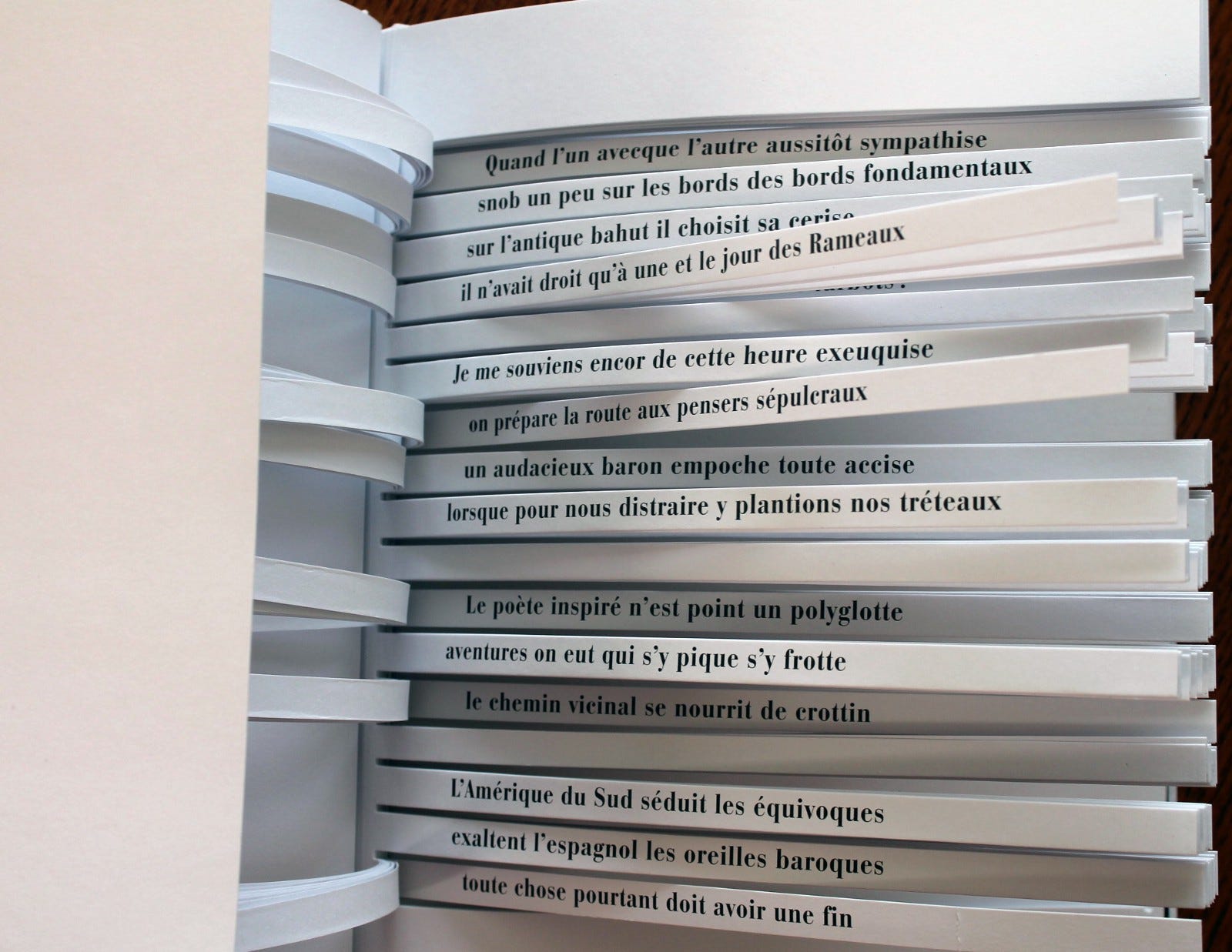
Cent Mille Milliards De Poémes - 10 pages, 10 lines cut and seperated, forming 200 million years worth of continuous reading
and why should there be this stuff called poetry to begin with, which strikes our hearts at such a magic angle graham swift ever after
Jacques Lacan that gets somewhere close to the experience of looking at a Rego drawing: ‘The reason we go to poetry is not for wisdom, but for the dismantling of wisdom.’